Tyrone Place
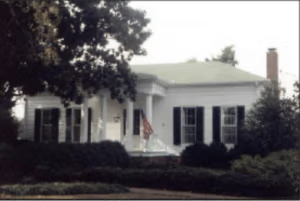
Records show that in the homes’ early history, owner Professor Swift, a teacher at the Female Institute, proved his skill as a topiary artist by pruning an avenue of cedars into shapes of different birds and animals and named the house “Avenue of Cedars.” The home was re-named “Tyrone Place” by Mr. and Mrs. James McNamee whose ancestors hailed from Tyrone County, Ireland.
The McNamee’s at one time also lived in the twin house next door and used Tyrone Place as a barn. The cows roamed in and out of ab opening created in a dining room wall where the fireplace had fallen to the ground. Restoration of this house was begun in 1969. A “his and her’s” bathroom wing was added in the late 1980’s. The basement, which was filled with water, snakes and rats, was dug out and restored in the early 1990’s. It was during that time that the finishing touches for the rest of the house were completed.
The architecture is a Greek Revival Raised Cottage. All of the doors and windows in the original part of the house are Greek or Egyptian Key design. The heart pine floors are original as well as the window panes and all trim moldings.
During its history, several prominent families in La Grange occupied the house. Among them were Jerome Hunter, a Methodist minister, the Bick Wilsons, and the L. E. Andersons.
The Civil War was kind to this home and it was spared from destruction by Sherman’s army because they were able to use the basement to make bullets. It is an “English basement”, partially above ground and contains the fourth fireplace in the house. The original brick floors are two feet below the existing handmade brick floors and were not unearthed during restoration.
Soldiers names can be seen carved in the rafters of the attic and were seen in the old cistern before it was filled with concrete. There was a stockade in the field to the south of the house. Other than these few tidbits of information, very little is known about this home.