Immanuel Episcopal Church
Holy Communion or Morning Prayer: Every Sunday at 11:00 a.m.
Children’s Sunday School: Every Sunday at 11:00 a.m.
Blessing of the Animals: TBA
Harvest Eucharist: TBA

Ever guided and impelled by the same spirit, vision and sense of mission that led to its founding in 1832, Immanuel Church, La Grange, Tennessee, is still a continually active Episcopal Church at the present time.
This Protestant Episcopal Church was first established as a mission in 1832, consecrated in 1843 with Reverend Samuel George Litton as its missionary and first rector.
Located an hour’s drive due east from Memphis, on Highway 57 through Germantown and Collierville, today La Grange is a quiet, peaceful town with less than 200 inhabitants. Sitting high on a bluff overlooking the Wolf River and north Mississippi, La Grange was an Indian trading post in the early 19th century and a thriving settlement by 1825. The town street plan was laid out and patterned after Philadelphia, PA by Samuel B. Harper, who was also the first Sheriff of Fayette County. The town was first incorporated in 1824.
Southwest Tennessee attracted a large westward flow of wealthy, educated and cultured people migrating primarily from the Carolinas and Virginia in the 1820’s. Included in this migration was the John Anderson family and Mr. Anderson’s mother-in-law, Mrs. Mary Hayes Willis Gloster, who came with a number of other relatives to La Grange from Warrenton, NC in 1827. Mrs. Gloster, a doctor’s widow, a devout Episcopalian and a very determined woman, was increasingly disturbed that there were no churches of any kind in La Grange. At the age of 52 with her son-in-law, she made a daring and dangerous horseback ride to Franklin, TN, through some 200 miles of wilderness to seek help on this from the Reverend James Hervey Otey.
The Rev. Mr. Otey was a young missionary priest and a schoolmaster who had come recently from Warrenton. He was Mrs. Gloster’s godson and Mr. Anderson’s good friend. He was to become the first Bishop of Tennessee.
His intervention brought another missionary priest, the Rev. Mr. Thomas Wright from New York, and in 1832 Immanuel Church was organized, the first Episcopal Church west of the Tennessee River. Later that same year the Rev. Mr. Wright helped establish Episcopal Churches in Jackson, Brownsville and Randolph, and Calvary in Memphis.
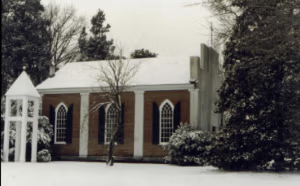
As La Grange continued to thrive, Memphis, 50 miles to the west and established only approximately 7 or 8 years before at that time, was generally considered a rowdy river town. For decades more sophisticated Memphians were to come to La Grange by horseback or horse-drawn conveyance, and later by the old La Grange-Memphis Railway (later known as the Memphis-Charleston Railway), to shop and to attend schools and cultural events. It was during this period of high promise and prosperity that the present Immanuel Church building was erected on Gloster-Anderson land by slave labor with handmade bricks and hand-hewn timbers from nearby virgin forestlands. The present building was consecrated by Bishop Otey in 1843. It is in the classical style of rural English village churches and, more specifically, a closely patterned copy of the Gloster family’s former Immanuel Church in Warrenton, NC.
La Grange was occupied by Union forces from the time of the fall of Memphis on June 13, 1862, until the end of the Civil War. Immanuel was confiscated as an ordinance depot, and later used as a Union hospital. The building was terribly abused. The pews and chancel furniture were used to make coffins for the Union dead.
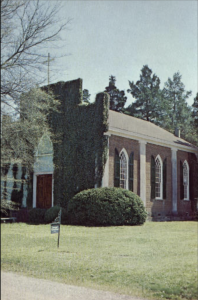
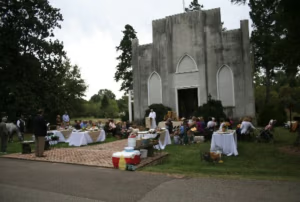
La Grange never fully recovered from the rigors of war, reconstruction and a changing economic order, but the church survived. Soon after the war’s end, the first of many periodic restorations at Immanuel was begun. The removal of a fake ceiling which had been added early in the century was undertaken in the 1950’s and finished in 1977. The old slave gallery—one of two in existence in this country—was opened up again. Original light fixtures were wired for electricity; copies of the original mullioned windows were installed; the original stucco façade restored; and refinishing revealed the true beauty of the heart of walnut used for the altar, pulpit, lectern and bishop’s chair. Modern heating, plumbing, and air conditioning were installed as well during this time. Efforts continue on the maintenance and restoration of the church building to this day.
A support group known as Friends of Immanuel secured a matching grant from the National Park Service through the Tennessee Historical Commission and a Bicentennial Grant to have Immanuel placed on the National Registry of Historic Places in 1972. This group is no longer active. Now we have a small and energetic congregation who give of their time, talents and treasures, all of which are welcome at Immanuel. They are ever mindful that we need reminders of our past to ensure, enrich, and give a sense of direction for the future. They are equally insistent that the preservation and restoration have been done not to make a shrine, but to keep the fabric of the church in shape, so that it has its original significance and its vitality in the present.
A lovely cemetery, ash garden and columbarium have been established on the east side yard of the church. Spaces are available for all Episcopalians and their families. Please contact the Church Warden for purchasing information.
For those who may be interested in contacting the Church Warden please write or call:
Mrs. Margaret Atkinson, Warden
Immanuel Episcopal Church
PO Box 21
La Grange, TN 38046
Margaret.erb.atkinson@gmail.com